
Robots often develop faults partway through a mission: a tire goes soft, a sensor drifts, a joint stiffens. The usual responses are to stop and wait for a human or to repair everything possible, and both can waste time. This paper looks at a narrower question: given where the robot is and what remains of its mission, which repair is actually worth doing?
ENCORE keeps a learned model of how well each repair tends to work and what it costs, rather than assuming every fix fully restores the robot. For each candidate repair, including doing nothing, it rolls the rest of the mission forward in the current environment and estimates the total cost. These rollouts are risk-aware, so a repair that is usually fine but occasionally disastrous does not win on its average alone.
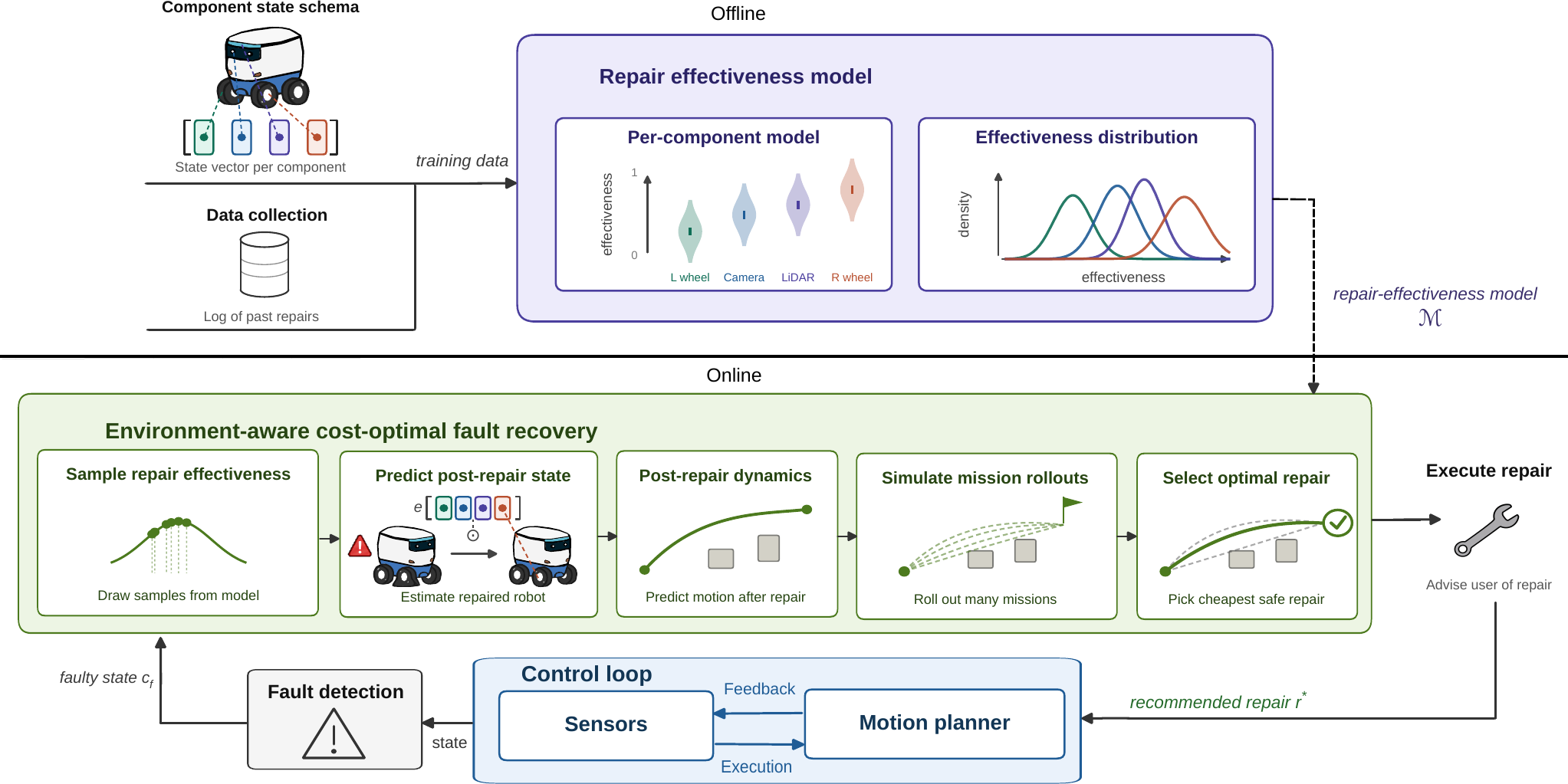
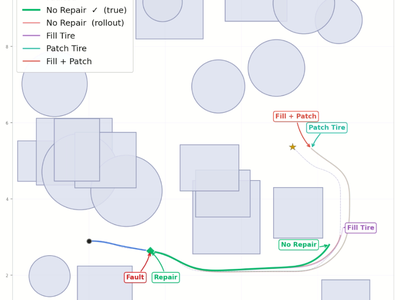
The figure shows an example. After a tire fault, the robot compares no repair, a patch, a fill, or both. Here, skipping the repair is the cheapest way to finish, because the route ahead is forgiving.
The paper is in preparation, and a preprint link will be added once it is available.