
Alenna Spiro
← All papersIEEE Conference on Decision and Control (CDC 2025) · Co-first author · Oral presentation

A Hybrid Framework for Efficient Koopman Operator Learning

Predicts nonlinear dynamics with a linear model. Semidefinite programming finds a Koopman operator, then the mappings into and out of its space are learned, so the observable dimension no longer has to be guessed ahead of time.

L. Jung, A. Spiro, A. Estornell, M. Everett, M. Sznaier

Part ofKoopman theoryArchitectureHybrid models

Ten-step forecasts from the true state on five test trajectories of each system, made by the hybrid model with pretraining (purple, solid) and the model of Lusch et al. (orange, dashed). The trajectories are those at the 10th, 30th, 50th, 70th and 90th percentiles of forecast error. On the fluid flow system the ten-step test error of the hybrid model is 35 times lower than that of the baseline, and on the pendulum it is less than half. On Lorenz the two errors agree within 2%. On the discrete spectrum system the baseline is more accurate.

Most interesting systems, such as robots, fluids, and power grids, are nonlinear, which makes them hard to predict and control. Koopman theory offers a workaround: lift the system into a larger space where its behavior becomes linear, so the well-understood tools for linear systems apply. The difficulty is finding that space, since exact Koopman operators are rarely possible to derive by hand.

Existing approaches each have a weak spot. Programmatic methods solve for the operator directly, but they depend on system-specific choices and become expensive as problems grow. Learning methods train a neural network to find the lifted space, but they are sensitive to hyperparameters, most of all the number of dimensions the lifted space should have, which usually has to be guessed.

This paper combines the two. Semidefinite programming first finds a representation of the linear operator, and a network then learns only the mappings into and out of the space that operator acts on. The optimization handles the structure, and learning handles the parts that are hard to write down. This reduces the effort needed to learn the operator and removes the need to fix unknown structure, such as the lifted dimension, in advance.
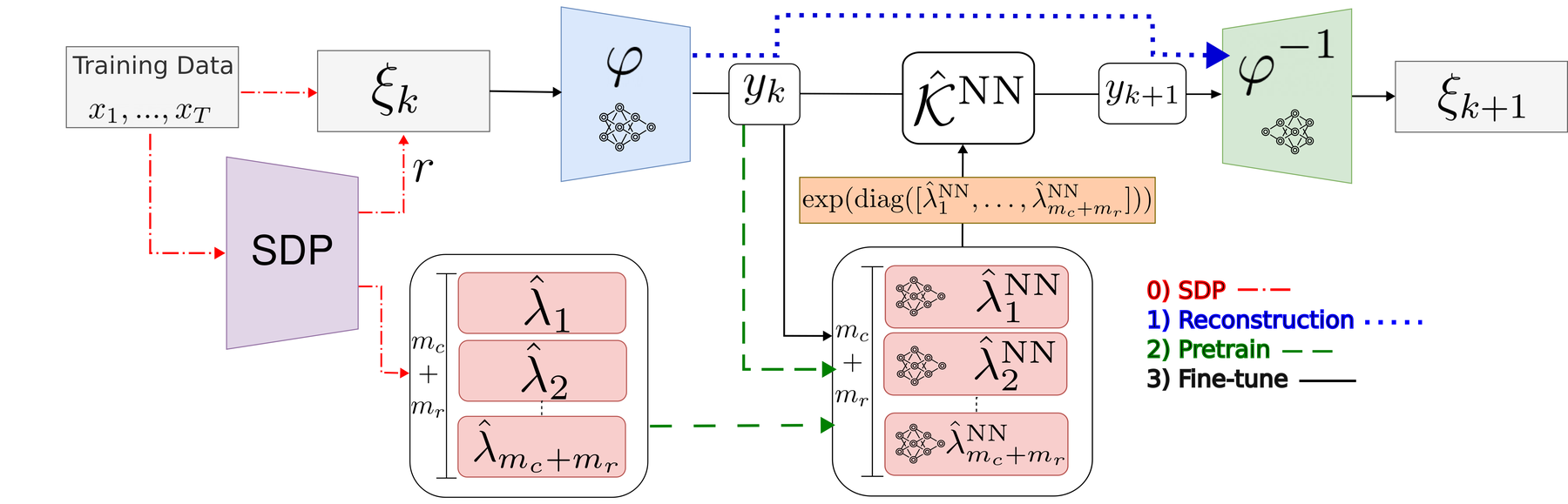
Architecture and training scheme of the hybrid Koopman framework
Model and training scheme, from the paper. Red: solving the SDP and choosing the size of the lifted space. Blue: a reconstruction phase that makes sure states can be recovered. Green: pretraining that fills in the operator with the SDP-derived eigenvalues. Black: the final path used for fine-tuning and inference.
Lumpy, a small round purple fish
This is Lumpy, the mascot of this site.

The Fish Hunt

Seven little fish are hiding around this site. Each one you find points to the next.