
Alenna Spiro
← All papersIEEE International Conference on Development and Learning (ICDL 2022)

Evaluating Sensorimotor Abstraction on Curricula for Learning Mobile Manipulation Skills

A developmental curriculum that gradually recruits sensors and motors, modeled on infant learning, improves sample efficiency by up to 10× on a mobile manipulation task and transfers to new domains without retraining.

O. Youngquist, A. Spiro, K. Doctor, R. Grupen

Part ofPerceptual priorsReinforcement learning

The learned transport policy in a recreation of the simulator, shown in real time. The robot searches for the object, approaches it with the path planner, preshapes its hands, grasps, and carries the object to the goal at the centre of the room. The policy chooses between two actions, the learned search and grasp skill and the transport controller. The panel on the right shows the controller that is running and the state of each controller. The last clip uses an object shape and three obstacles that were not present during training.

Infants do not learn to use their whole body at once. They start with a few controllable pieces, such as eyes, then hands, then reaching, and add more as each becomes reliable. This paper asks whether a robot learns faster when it is taught the same way.

A simulated mobile robot has to find and handle objects in a room, as shown in the figure below. Instead of giving the learner every sensor and motor from the start, a developmental curriculum introduces them gradually. Early stages work with a small, simple set, and later stages add more as earlier skills settle.
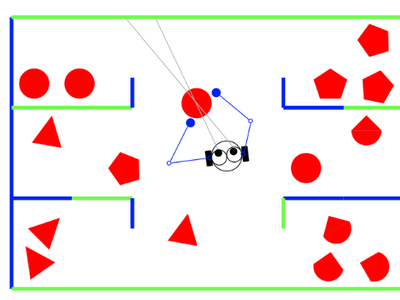
Simulated mobile manipulation environment
The simulated mobile manipulation environment.

The control policies learned at each stage form a sensorimotor state abstraction: a compact picture of the world that the next stage can build on, instead of starting from raw sensor readings. A small set of parameters controls when each sensor and motor is recruited, which lets us compare different curricula against a learner that gets everything at once.
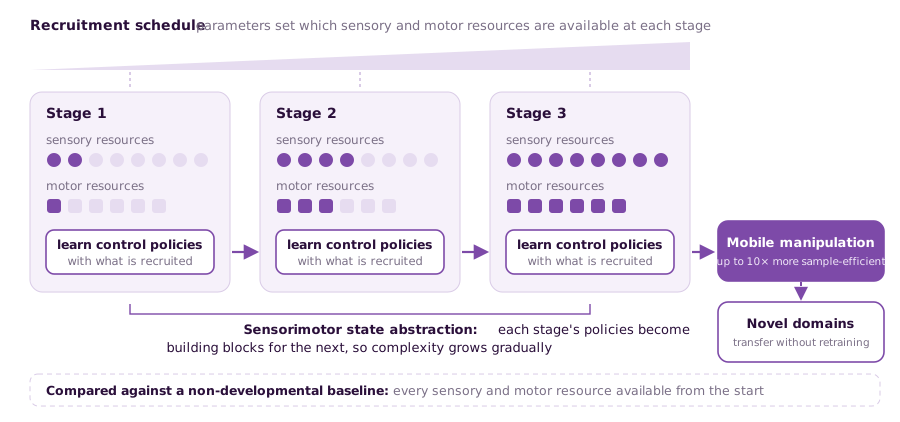
Developmental curriculum: a recruitment schedule adds sensory and motor resources over three stages; each stage's learned policies become a state abstraction for the next, leading to sample-efficient mobile manipulation and transfer to new domains
Overview of the approach. A recruitment schedule makes more sensory and motor resources available at each stage. The policies learned at one stage become the building blocks for the next, and the result is compared against a learner given every resource from the start.

The curriculum made learning up to 10× more sample-efficient on the mobile manipulation task, and the skills learned this way transferred to new domains without retraining.

Lumpy, a small round purple fish
This is Lumpy, the mascot of this site.

The Fish Hunt

Seven little fish are hiding around this site. Each one you find points to the next.